
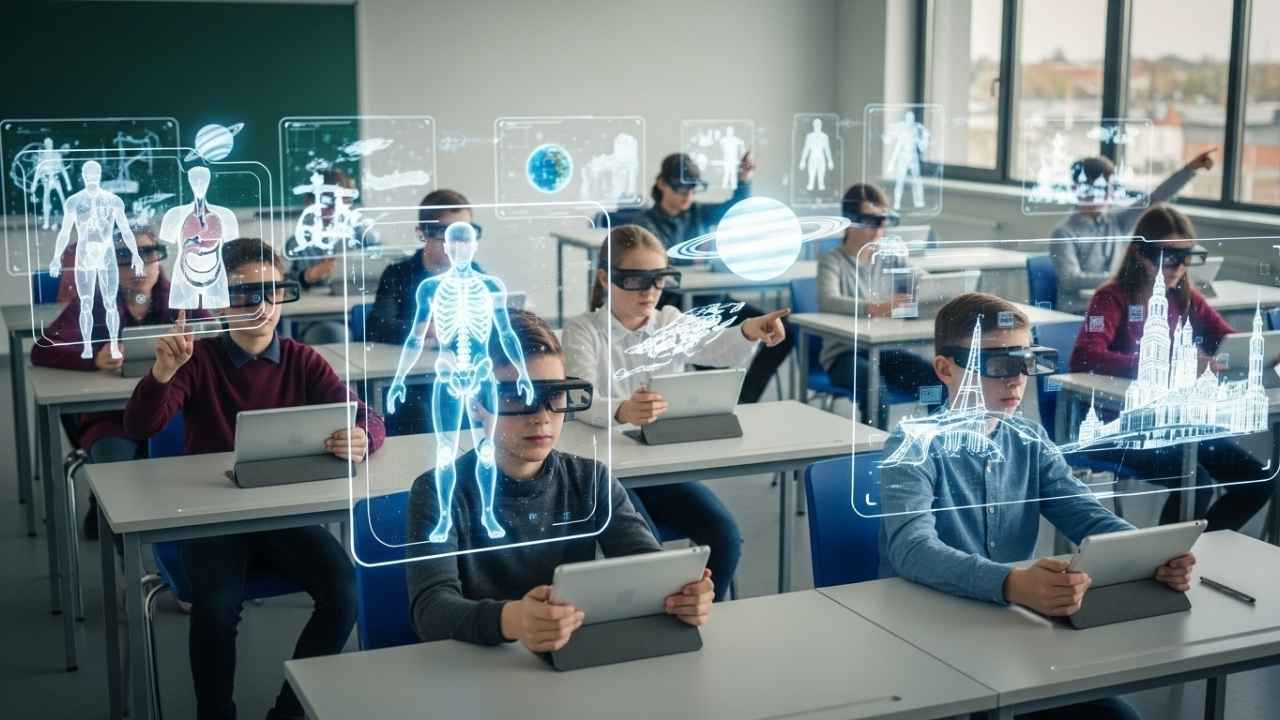
In today's digital world, classrooms look very different than they did even 10 years ago. The rise of augmented reality (AR) and virtual reality (VR) is transforming the way we learn and making the learning experience more engaging and personalized. As one who has witnessed the improvement in education that technology brings, I think that augmented reality in education has the potential to truly revolutionize education in the classroom.
You and I both understand that a traditional classroom can be limited at times. Students read from textbooks, listen to lecture and perhaps watch a video or two. But with the use of augmented reality, we're able to create interactive learning environments that are capable of letting students go beyond the page. Imagine students in virtual field trips, running AR simulations, or exploring virtual objects that are projected into the real classroom. This is what makes AR so exciting—it has the potential to make learning interactive, immersive and hands-on.
What Is Augmented Reality in Education?
Before we discuss the benefits, let's first define augmented reality clearly. AR technology is technology that adds digital elements to the real world. For example, when you view your classroom with an AR app, you might see 3D shapes, hands-on maps or animated models layered on top of your classroom desks and walls. These are referred to as AR overlays, and they are useful in creating an interactive learning experience.
It's important to know the difference between AR and VR:
Virtual reality (VR) is the creation of an entirely virtual environment. Students put on headsets and the VR experience is what puts them in a new digital world.
Augmented reality (AR) maintains the view of the live classroom, but adds digital overlays. AR lets students view and interact with the physical world and the virtual world simultaneously.
When teachers incorporate AR in education, they enhance the learning process as they are providing students with tools that make abstract ideas easy to understand. AR enables a new form of learning, one that fits various learning styles. Whether a student learns better by seeing, doing or interacting, AR can help.
This is the reason why many schools are starting the application of AR and VR technologies. As these tools expand, they're transforming learning and paving the way for the future of education.
Benefits of Augmented Reality for the Classroom
The advantages of employing augmented reality in the classroom are obvious. As you and I ponder the difficulties of keeping students engaged, AR is a solution that can help make teaching and learning more effective. Let's examine the major benefits.
AR Makes Learning Interactive
When students use AR tools, they don't sit and listen—they participate. By implementing augmented reality in schools you can create lessons that feel like games or experiences instead of lectures. For example, an AR application can make a science diagram come alive by providing moving 3D models of the human body. This type of hands-on learning experience is what makes learning stick.
Support for Different Learning Styles
Not all students learn in the same way. Some need visual support, others need practical activities, some do best with listening and discussion. AR solutions address these needs by providing a variety of ways to learn the same concept. AR content can display diagrams, play audio or even permit direct interaction. By doing so, AR helps to bring personalized support to different learning styles.
Immersive Learning Experiences
Traditional textbooks may tell you about history, but AR in education can help bring the past into the present. Imagine holding up a tablet and having a virtual object such as an ancient building appear in the classroom. Or imagine students using location based AR to explore landmarks in real time. These immersive forms of learning are much more memorable than reading a page of text.
Improved Student Learning Outcomes
Studies already provide grounds for thinking that AR aids in understanding subjects more comprehensively because it leads to interactive learning environments. The nature of AR is visual and practical—which helps explain such hard topics as math formulas, science experiments, or geography lessons. AR makes things easier to understand because concepts are shown, rather than just told.
Improved Engagement and Motivation
As a teacher you've probably asked yourself this question: how do I keep my students focused? The answer is very simple, make lessons more interesting. AR offers exactly that. When students view AR overlays of digital material on real-world objects, they're paying attention. AR can take boring lessons and make them exciting and that leads to more motivation to learn.
Personalized Learning Opportunities
One of the most exciting aspects of using AR in education is that it is adaptive. An augmented reality app can adapt the pace, provide immediate feedback and align the learning objectives of each student. This supports personalized learning, which many experts consider to be the future of education.
Virtual Field Trips and Simulations
Schools may not always have the budget to afford real field trips, but AR and VR powered virtual field trips are changing that. Students are able to "travel" to space, explore the ocean, or walk through historic sites without leaving the classroom. AR simulations also allow students to practice experiments or problem-solving in a safe environment. This opens the door to what's possible in a traditional classroom.
Preparing Students for the Future
The use of AR in schools also prepares students for modern-day careers. Many industries already make use of AR technology—from medicine to engineering. By allowing students to use AR apps in class, you are preparing them for a future in which AR and VR will change not only the way they learn, but how they go about their work.
Uses of AR in the Classroom
Now that we've looked at the benefits, let's take a look at what real applications of AR are already doing in terms of revolutionizing learning. You'll find out how teachers from across the USA are using augmented reality to make lessons more interactive.
Science and Biology
In a traditional classroom, diagrams can only go so far. With AR apps, students can walk through 3D models of the human heart, chemical reactions, or the solar system. AR superimposes digital information directly on real-world objects and students can rotate them and examine them in detail. This makes science a learning experience that is hands-on.
History and Geography
Imagine taking your students on virtual field trips to the pyramids of Egypt or the Great Wall of China. With virtual and augmented reality, you can take these sites into the classroom. Students can walk around monuments, explore maps, and understand history in an immersive environment of learning.
Mathematics
Abstract numbers are often confusaing for students. AR helps in making learning math more visual. By using AR simulations, students can watch 3D graphs, geometric shapes, or fractions come to life. This makes the process of learning easier and helps different learning styles.
Language Learning
Flashcards and memorization can be boring. But when students use AR flashcards, the words spring to life with sound and animation and images. This type of interactive learning keeps them motivated and aids them in memory retention.
Special Education
AR solutions are especially helpful in the support of students with learning challenges. AR offers step by step instructions, individualized learning paths, and visual cues that help them succeed in ways the traditional classroom can't.
These applications of AR show that it's not all about fun—it’s about transform learning and making education more effective.
AR Tools and Apps for Education
To implement these ideas into your own classroom, you'll need the right AR tools. Many augmented reality apps are teacher- and school-focused. Here are a few examples:
Google Expeditions – Provides virtual field trips that bring students anywhere in the world.
Merge Cube – A cubelike handheld tool that allows students to interact with 3D AR content such as planets or molecules.
AR Flashcards – Great for younger students that are just beginning to learn letters, words, and shapes.
AssemblrEDU – An easy AR app for building interactive lessons.
These tools make the implementation of augmented reality much easier. With a smartphone, tablet or headset, students can start enjoying the AR experiences immediately.
When considering which is the best AR app, consider your objectives:
Do you want to make science lessons interactive?
Do you want to bring history to the classroom?
Want to support personalized learning?
By aligning the AR app with your learning objectives you can ensure the effectiveness of AR in your classroom.
Implementing Augmented Reality in the Classroom
You might be thinking to yourself: how do I actually implement AR in my teaching? Here's a basic step by step guide.
Start Small
You don't need costly devices to get started. Many AR apps are smartphone- or tablet-based and available for use with devices that students already have. Try a simple Augmented Reality App for Flashcards or Science Lessons first.
Aligned With Learning Objectives
Don't add AR just for fun. Always link it to your lesson plan. For example, use AR simulations for teaching science experiments, or virtual field trips for teaching geography. This way, you can make sure that the use of augmented reality is serving your teaching goals.
Train Teachers and Students
Teachers need to feel confident to use AR in Education. Take time to explore the software for education, test the AR tools and show students how to interact with them.
Manage AR Content
Make sure that you can easily manage AR content. Many AR solutions have inbuilt libraries of lessons. Some even let you develop your own content that is tailored to your learning process.
Evaluate Effectiveness
After you integrate AR, ask yourself this thoughts: Did it help students learn? Did it make the learning experience better? Feedback and performance data can be used to refine the way you approach learning with AR.
By following these steps, you can implement augmented reality in a way that's simple, effective, and scalable.
Role of AR and VR in Future of Education
The future of AR and VR is filled with exciting possibilities for teachers and students alike. Experts agree that AR and VR technologies will play a large role in the future of education.
Here's what I see coming:
Immersive Classrooms: In place of textbooks, students will learn with interactive AR content.
Virtual and Augmented Reality Together: AR is used to bring digital objects into the real classroom and VR is used to create full virtual environments.
Personalized Learning at Scale: AR enables students to learn at their own pace and VR tailors lessons to student progress.
Career Readiness: By learning with AR and VR, students are preparing for careers in the future where these technologies are standard tools.
As the use of AR rises, schools in the USA will witness revolutionizing learning on a large scale. This will alter our definition of what the classroom is.
Problems in Using Augmented Reality in Schools
Of course no technology is perfect. When you're using AR in education, there are challenges to keep in mind:
Cost: Some AR solutions and devices are costly. Schools will have to decide whether the gain is worth the loss.
Technology Access: Not all students have smartphones or tablets that are compatible with AR apps.
Screen Time: Excessive reliance on digital tools can lead to a decrease in real-world interaction. Teachers need balance.
Teacher Training: You need to train so that you can use it effectively. Without it AR may not be able to live up to its full potential.
Content Quality: Not all AR content is high quality. Teachers should preview apps prior.
By planning carefully, schools can overcome these challenges and make the most of augmented reality's benefits.
Summary
Augmented reality (AR) has been revolutionizing the classroom with interactive and immersive learning experiences. Unlike virtual reality (VR), which creates a completely virtual environment, AR takes virtual objects and overlays them into the real classroom to make lessons more engaging. Teachers are using augmented reality with science, history, math and even special education to help students with different learning styles. Popular AR tools and apps make it possible for students to take virtual field trips, explore 3D models and have a personalized learning experience. While there are challenges to be overcome, such as cost, training, and screen time, the future of AR in education is a promising one that will help to revolutionize learning environments.